May 2026 · Fonto Insights · Pharmacy Retail
Fonto's consumer spending and customer experience data for the March 2026 quarter reveals a sector in transition: one shaped by a dominant, price-driven competitor, the blurring of lines between pharmacy and grocery, and an emerging role for pharmacists in primary healthcare. With spend per customer up 11.6% year-on-year and market penetration holding stable, the fundamentals are healthy. The challenge and the opportunity lies in what happens once customers are inside the store.
Spend per customer
Pharmacy retail spend per customer reached $219 in the March 2026 quarter, representing 11.6% growth — virtually identical to the 11.7% recorded in the same period last year. That consistency points to a category where customers are spending more on each visit, even as basket size growth slowed slightly during the quarter.
Frequency of purchase and market penetration have remained stable, suggesting that the volume story — more people buying more often — has plateaued. The growth engine now runs primarily on higher spend per occasion, which makes the in-store and online experience increasingly critical to sustaining momentum.
Key figures — March 2026 quarter
- $219 — Spend per customer
- +11.6% — Year-on-year growth in spend per customer
Chemist Warehouse: redefining the category
Chemist Warehouse continues to redefine how consumer shop the category. The March quarter saw the retailer add 450,000 more customers compared to the prior corresponding period, while simultaneously growing frequency of purchase by 7.5% and average basket size by 3.9%. The result is a spend per customer figure of $166, achieved across approximately 3.5 purchases per person, against a category-average basket of $43.
Chemist Warehouse was purchased by close to half of all Australians aged 18+ during the March quarter. Its high volume, strong pricing, and wide product ranging model has become the reference point against which every other pharmacy brand is now being assessed.
Yet there is a telling paradox in the data. Despite this commercial dominance, Chemist Warehouse ranks 8th, 10th, and 14th across Fonto's detailed customer satisfaction measures. It is a brand that wins on price and penetration, but not on the experience dimensions that drive genuine loyalty.
"Chemist Warehouse drives volume via price, and contributes significantly to grocery migration despite customer satisfaction and service levels ranking towards the bottom of the category."
- Fonto, Moments in Pharmacy, May 2026
Priceline: a challenging March quarter
While Chemist Warehouse has been adding customers and frequency, Priceline experienced a more challenging March quarter. Customer numbers fell by 340,000 compared to the prior year, frequency of purchase declined 1.9%, and spend per customer growth moderated to just 0.9%. Average basket size did edge up 2.8%, suggesting that those who do visit Priceline are spending more, but fewer of them are coming through the door.
The contrast with Chemist Warehouse's trajectory is stark, but it is not necessarily a permanent state. Priceline holds a distinctive asset that Chemist Warehouse cannot easily replicate: loyalty program engagement. Priceline leads all tracked pharmacy brands on the proportion of customers who use their loyalty card at the point of transaction, with 2/3 of customers doing so.
The grocery migration: pharmacy is gaining ground
Fonto data shows that when customers are asked why they chose to buy a particular item from a pharmacy rather than a supermarket, the top cited reasons include pricing, product availability and convenience.
For over-the-counter medicines, vitamins, and skincare, the reasons customers choose pharmacy over grocery vary significantly. This matters for suppliers and ranging decisions: the pharmacy channel is not winning these sales on one dimension alone, and the opportunity differs meaningfully across product types.
This migration dynamic has become a genuine growth engine for the category — particularly for Chemist Warehouse, whose pricing model makes it competitive with supermarkets on non-prescription health, beauty, and personal care items.
Delivery apps: grocery is charging, pharmacy has room to grow
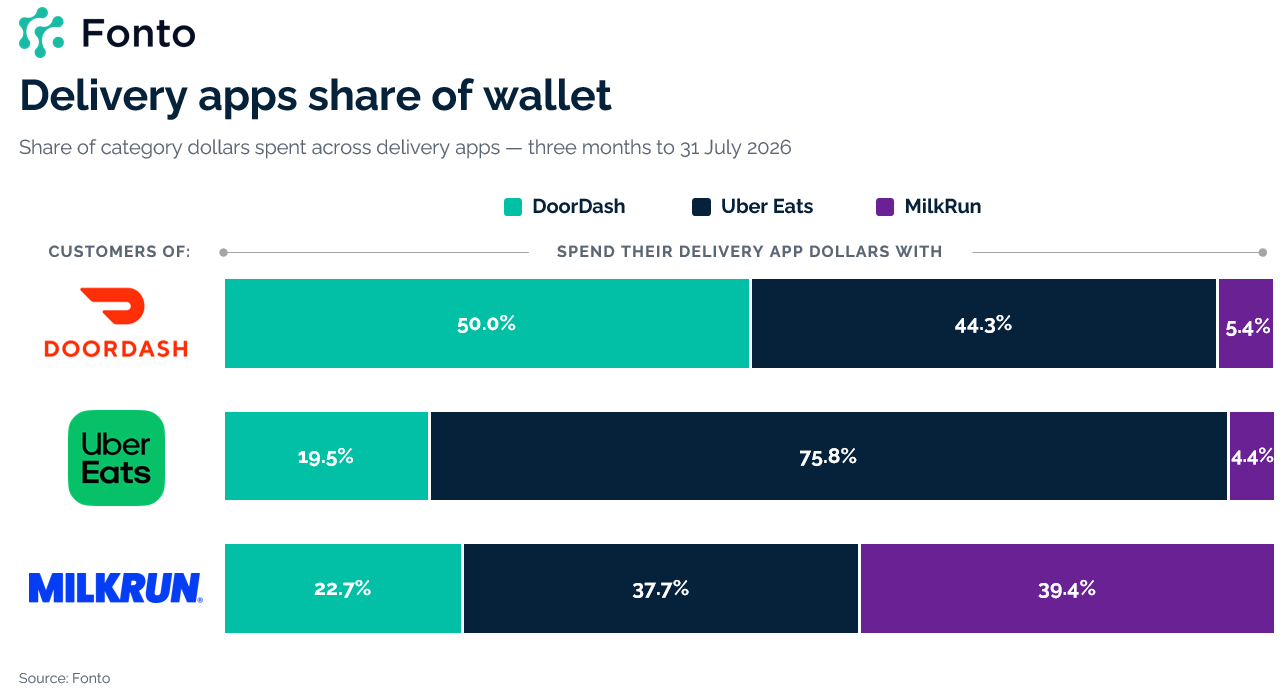
The delivery app landscape reveals an important competitive context for pharmacy. In the six months between September 2025 and March 2026, grocery's share of delivery app transactions grew from 14% to 28%, with an average basket size of $56.80. Restaurant and QSR orders declined from 75% to 64% over the same period, reflecting a broader shift in how consumers are using delivery platforms.
Pharmacy currently represents a small share of delivery app volume — but the category's presence in non-food grocery orders points to an emerging channel for health, beauty, and baby products. As grocery delivery grows and consumers become more comfortable purchasing non-food items through these platforms, pharmacy brands with a strong delivery proposition stand to benefit.
Pharmacy vs GP: convenience is reshaping primary care
Beyond the retail metrics, one of the most consequential findings in the data relates to how consumers are choosing between pharmacists and GPs for health services. Across categories including health checks, vaccinations, leave certificates, and general health advice, Fonto data shows that convenience is the primary driver when customers opt for a pharmacy instead of a GP appointment.
This trend has been amplified by the expansion of telehealth services — with at least one major operator (Hola health) now offering 24/7 availability and integrations with Health Engine, HotDoc, Uber Eats, and DoorDash following a Series A raise in 2025. The distribution model for pharmacy services is changing, and retailers who understand the intersection of healthcare access and consumer convenience are well positioned to capture this shift.
The bigger picture: AI, automation, and a category in transition
The longer-term structural backdrop for pharmacy retail includes the growing role of AI and automation in both dispensing and patient care. Applications range from improved dispensing accuracy and detection of adverse drug reactions through to freed-up pharmacist capacity for direct patient engagement and better connectivity to health records. For pharmacy retailers, this points toward a future in which the pharmacist's role becomes more consultative — and the in-store and digital experience becomes correspondingly more important.
For pharmaceutical companies, AI promises to halve time-to-market for clinical trials and reduce the cost of bringing new products through the pipeline. The downstream effect for retail is a faster-moving product landscape, with more options entering the category at shorter intervals.
To access Fonto's Moments in Pharmacy research, reach out to the team at insights@fonto.com.au